Latest Cavity Trays News http://www.cavitytrays.com/feed All the latest news for cavity trays. en-usCavity Trays Approval Advantagehttp://www.cavitytrays.com/news/view/89Yeovil-based Cavity Trays Ltd that has just secured additional approvals from LABC Registered Details (Local Authority Building Control) recognises the confidence afforded with independent product approval. 

Cavity Trays already holds European Technical Approval and is the only UK manufacturer of preformed cavitrays able to claim this status. Now it has had further products assessed and approved by individual local authorities through LABC Registered Details.   

The latest products to join the approval ranks are as follows: 

Type BA   

Preformed curved cavitrays for arch openings available in all arch styles, shapes and dimensions. 

Type C

Preformed straight cavitrays for use with all models of lintels providing a harmonizing compliant arrestment against damp ingress. Supplied to suit the construction profile required complete with stopends and caviweeps. 

Cavicloaks

Extensive range of profiled cloaks for building into both skins and manufactured in a material selected for its water and gas barrier qualities. Cloaks also supplied for building into one skin only where a self-supporting medium independent of the inner skin is preferred. 

Specifiers builders and developers can be assured the approved products have been rigorously checked by LABC members and use these products with added confidence. 

Dual approved products (ETA + LABC Product Type Approval) are accompanied with a cavitray warranty via an insurance-backed performance undertaking at no additional charge. Three more reasons to use approved cavitrays from Cavity Trays of Yeovil, the company with the longest track record in its specialised field. 

Cavity Trays Limited   Administration Centre  Yeovil  Somerset  BA22 8HU               

T: 01935 474769 

F: 01935 428223    

enquiries@cavitytrays.co.uk

www.cavitytrays.co.uk                                                                                                                      

]]>
2013-04-22
House Builders on The Same Levelhttp://www.cavitytrays.com/news/view/87House Builders On The Same Level?

Where access into a building is required to be at the same level internally and externally, the designer must consider how damp and water transference is to be prevented?

At the opening threshold the internal floor must provide connection with the external approach but in a manner that will not support wet permeating inwardly.  There are also the reveals to consider: At the corners of each opening the floor dpc membrane must integrate with the threshold dpc and in turn must integrate with the vertical reveal closing dpc. These three are joined by the horizontal inner and outer skin dpc’s that are often at a different level – because of the statutory requirement for them to be not less than 150mm off the external ground level.

Looking below floor level, BS 8102 can come into play. Section 6.3 states waterproofing protection falls into three classifications: 1. Barrier protection. 2. Structurally integral protection. 3. Drained protection. Threshold designs must be able to drain conventionally yet be isolated against damp transference whilst permitting integration with the structure adjacent. An approach is required that is technically a cavity wall dpc capable of performing above and below ground level.

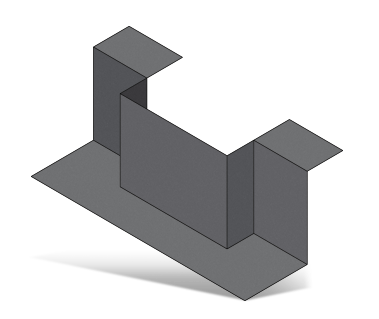
The Type LTT by Cavity Trays provides a standardised damp prevention solution for use on inner and outer skins supporting a level threshold. It isolates an area susceptible to damp transference, permitting flooring, insulation, dpc’s and membranes to merge with both skins that are themselves isolated from dampness at the point of convergence.

The Type LTT is manufactured in dimensions to accommodate all standard door openings and skin thicknesses, as well as being offered on a bespoke basis. Preformed from solid polypropylene dpc, it requires bedding in position only. (The exception being when used on the outside skin where it may be trimmed back following installation of the frame).

The wrap-around section at each end of the Type LTT provides a positive upstand against which a vertical cavicloser may locate.

These wraps also form protected areas into which dpc running horizontally in each skin can terminate. (such dpc’s are normally higher than the threshold level).

Regardless of whether the floor construction terminates on or against the inner skin or outer skin, damp transference through the masonry or rising within it cannot permeate inwardly as each skin is an encapsulated and isolated structural element. The threshold is protected.

Compatible compressible thermal cavistops are available for fitting between the Type LTT where thermal enhancement is required.

Type LTT trays are extensively used to provide a consistent preformed approach when constructing level thresholds in private, commercial, educational and industrial buildings. Type LTT Level Threshold Trays are popular with house builders seeking a standardised level threshold specification solution.

Cavity Trays Limited   Administration Centre  Yeovil  Somerset  BA22 8HU               

T: 01935 474769 

F: 01935 428223    

enquiries@cavitytrays.co.uk

www.cavitytrays.co.uk                                                                                                                                 

]]>
2012-11-23
Flashing Functionality an Important Consideration in Severe Weather, advises Cavity Trays Ltdhttp://www.cavitytrays.com/news/view/86Cavity Trays Ltd, the longest-established specialist in its field now has flashing options available across its range of approved cavity trays. There are now four BBA flashing materials from which the client may select: Lead,  Synthetic,  Copper and Aluminium. This extends the clients options pending the adjacent roof type and finish, location and aesthetics. 

But, Cavity Trays has announced it is not reducing the dimensions of its flashings, despite alternative manufacturers offering trays with flashings that do not match the length of the tray. 

‘Our approved trays are accompanied with a performance undertaking’ commented a company spokesperson, ‘and our Type X tray for gable abutments has high-exposure rating. Adequate flashing laps can be critical especially in locations of variable exposure – a view promoted by the LSA.  We have experimented with varying flashing dimensions but having identified the adequacy of our current flashing dimensions in relation to tray size and flashing interfacing, and do not wish to reduce the intended cover margins. 

Exposure tests have highlighted the extent by which wind-driven rain can challenge the leading edge of stepped flashings. Penetration behind and beyond the leading stepping edge must be anticipated. 

                                                                                                                                                  By ensuring the relationship between trays (and thus between flashings also) extends sufficiently to arrest wind-driven rain, dampness can be prevented from permeating inwardly below the abutting roof-line.But there are accompanying considerations such as the tail of our flashing being shaped to permit transitory drainage and the flashing/tray union being bonded within a bosem jaw.’

Further information about the Type X trays can be found in: Gable Abutments, volume 21. Available upon request.

Cavity Trays Limited  

Administration Centre  Yeovil  Somerset  BA22 8HU               

T: 01935 474769 

F: 01935 428223    

enquiries@cavitytrays.co.uk

www.cavitytrays.co.uk  

]]>
2012-11-02
When Laying A Slate Roof to NHBC Standards Consider A New Version of A Traditional Ventilatorhttp://www.cavitytrays.com/news/view/85The NHBC advises that roof slates conform with BS EN 12326 and importantly they are accompanied with documentation to support the water absorption, carbonate content and reactive metallic materials tests. (A1, S1 and T1). This is to ensure the finished roof matches the proven pass or fail objectives and standards of BS 680. Without this accompanying commercial documentation (often called ACD’s’), the current BS EN 12326  does not embrace the comparable qualities the NHBC seeks. 

When it comes to ventilation within the compliant slated roof surface, the specifier now has a new option: The mandatory levels of air throughput can be provided using a proven but modernised traditional approach manufactured from a proven traditional material. Importantly, as with the roofing slates, documentation is available to confirm the compliant qualities of the material. 

The Lead Slate Roof Ventilator (Type LSRV) is used to promote airflow in and out of the roof space, or as a dedicated bathroom or kitchen ventilation outlet. Manufactured from code 4 milled lead to BS EN 12588, externally its appearance is traditional. The use of natural lead means it is long lasting whilst benefitting the accompanying ability to sympathetically weather with the roof covering. 

 The Type LSRV sits comfortably with all slate sizes and requires minimal work to incorporate within slate runs. Natural lead tempers into slate undulations so the Type LSRV accommodates variations that alternative materials cannot. 

The airflow aperture incorporates a stainless grille to diffuse wind impact and minimise water entry. Within the ventilator body, the spigot connection rises to function as an elevated outlet and water-check dam against rain ingress. The spigot also projects downwardly into the roof space to service roof space air evacuation.  A flexible hose may be connected for specific room extraction. (90mm, 110mm or 150mm).  The Type LSRV is supplied with a base size to match the slate dimensions. As the base size increases so does the maximum possible airflow from 3000mm to 8000mm sq².   

The Type LSRV is for use in new slate roofs and existing roofs requiring upgrading. When a property is a Listed building or within a Conservation Area, there are strict laws guarding construction and craftsmanship. The Type LSRV may be considered for use on such buildings where an enduring roofing material that has been used since Roman times is aesthetically and sympathetically the preferred medium. 

Product name:

Type LSRV  Lead Slate Roof Ventilator.

Manufacturer:

Cavity Trays Ltd BA22 8HU.


]]>
2012-10-10
Go Round the Masonry Bend with Assured Detailhttp://www.cavitytrays.com/news/view/84Go Round the Masonry Bend with Assured Detail  

Curved cavity walls and spherical corners have in the past posed problems for designers requiring sloping roofs to converge with the shaped masonry that might be concave or convex.  There are a number of considerations: 

The dpc within the wall and the flashing need to be of a different shape and size at every intersecting course. This is because the actual angle of intersection changes, despite the roof pitch remaining constant. 

How does one determine the optimum dimensions so the protection in each lower course integrates with the protection in each higher course in a manner that is watertight and continuous? 

How is the upstand in the cavity supported given that the inner skin is curved and conventional dpc cannot expand to compensate? 

What happens within the bedding course where the dpc is required to either elongate or contract as the convex or concave masonry turns – roll dpc cannot do so? 

If the inner skin is built in block work, what happens when the nearest course you rely upon to provide support for your dpc is too high or too low? 

Externally the flashing is required to act as a waterproof medium to link the wall with the roof tiles. But how can one join the flashing and the dpc so the union is watertight? 

How is wind-driven rain prevented from entering under the flashing leading edge where it dresses vertically against the masonry? The amount of water-wash traversing a curved wall is considerably more than that flowing over a straight wall because of gravitation and the windscreen deflection effect. 

The solution is to use preformed individual components, each of which is designed to exactly match the requirements at every intersecting course. These are called Type X cavitrays for curved walls and are based on the proven design awarded European Technical Approval. 

The advantages of using preformed cavitrays are numerous:

Fabrication on site is eliminated – there is no measuring, no cutting and no wastage. Preformed also means the shape is already determined – installer mistakes or oversights need not be a consideration. 

Each cavitray has its own adjustable cavity upstand.

There is no requirement to locate and build into an inner skin course as upstands are self-supporting.

Every tray has an integral end upstand that rises within the masonry at the inboard end to provide a vertical link to the tray above. Thus as each tray is laid it integrates with the adjacent tray. 

Where trays are supplied with the flashing already attached the traditional need to rake out joints and introduce flashings separately is eliminated. The union is pre-established. 

Because each cavitray and flashing overlaps the next cavitray and flashing, any wind-driven rain that seeps under a vertically dressed flashing leading edge does not come into contact with the masonry under (unlike conventionally cut running flashings). The overlap configuration provides a secondary layer to arrest such water, preventing it from permeating towards and under the adjacent sloping roofline. 

Cavity Trays Ltd undertakes to calculate concave and convex abutment requirements / schedules for clients. Each tray is numbered and the mason has only to numerically build in trays as the wall is raised. Petheleyne is used for the manufacture of each tray, having been identified as the most accommodating and durable of all dpc materials tested for such purposes. The external flashing may be selected from either lead or Perform – a BBA approved synthetic alternative. 

Cavity Trays Ltd is the only cavity tray manufacturer awarded European Technical Approval. Trays benefit a performance undertaking for the benefit of architect, builder and client.             

Further information from Cavity Trays Technical Manual number 22.

]]>
2012-08-17
Latest Book of Wise Decisions 2012 Edition now availablehttp://www.cavitytrays.com/news/view/83New Building Construction Details Pocket Book

Requested by Over 96%* of Industry Professionals ….is Free

Many decades ago a small pocket book arrived on the building scene. It contained information on a range of building practices together with some good sound advice. It rapidly became a useful reference source and aide memoir for builders and architects. 

July 2012 sees the publication of a new edition,  It is now thicker and contains even more data. The handbook is called: ‘The Book of Wise Decisions’. Many consider it the definitive guide containing building details and best practices relating to the building envelope. 

It’s publisher, Cavity Trays Ltd is the longest-established specialist in its field and the only one awarded European Technical Approval. The handbook steers specifier and contractor in the direction of compliant solutions that are cost effective and easy to use. 

And if you cannot see what you are after in the handbook, you can access a bespoke service.  It offers purpose-made construction detail solutions at a speed normally associated with stock items. 

The Book of Wise Decisions is printed in full colour, produced in A6 size, and available free of charge to industry professions. 

*At a recent survey conducted at DCE CPD seminar events, over 96% of readers of previous editions requested the latest edition be sent to them as soon as available. Many asked for multiple copies, so they also have one to hand in the office, site hut and even the builders van! 

Solutions offered within the publication are accompanied with a performance warranty.          If peace of mind is a quality sought by any industry professional, then The Book of Wise Decisions is an essential read. 

Note:

The 2012 version includes specification updates and enhancements, plus construction solutions on protecting the building envelope from damp, establishing thermal barriers, fire barriers, acoustic barriers and ventilating structures. Cavity Trays is the only tray manufacture awarded European Technical Approval. 

The new 2012 edition of The Book of Wise Decisions is available free of charge to industry disciplines on request from Cavity Trays Ltd Yeovil Somerset BA22 8HU - REQUEST YOUR COPY TODAY!

]]>
2012-07-02
Cavity Trays More Customer Benefitshttp://www.cavitytrays.com/news/view/77Cavity Trays More Customer Benefits

Cavity Trays of Yeovil has announced it is extending the use of Petheleyne in the manufacture of its products. 

‘Petheleyne has proved so reliable and accommodating on site that we have decided to extend its use across our range of trays’ commented a Company spokesperson. ‘It has better flexibility in colder temperatures and has proved it to be the most reliable of materials. The cold can cause some materials to become too rigid whereas Petheleyne remains effective in a wide temperature range’ 

Petheleyne solid dpc is the material already used by Cavity Trays Ltd in the manufacture of its award winning products granted European Technical Approval. No other tray manufacturer holds this standard. 

Accompanying the European Technical Approval held by Cavity Trays is a long-term performance undertaking in which the functionality of its products is guaranteed for the benefit of Architect, Builder and Client. 

The Company spokesperson went on to clarify:

‘European Technical Approval and the performance undertaking are just two of the accompanying qualities customers receive when they use our products. With the phasing in of Petheleyne at no additional cost to the customer we are pushing customer benefits further. We are the only Company offering this’. 

Cavity Trays is based in Yeovil Somerset and is the longest-established tray company. Its products are extensively used in many countries in new and refurbishment work and in remedial applications to replace traditional methods or alternatives that have proved inadequate.

Cavity Trays Limited Administration Centre Yeovil Somerset BA22 8HU

T: 01935 474769

F: 01935 428223

enquiries@cavitytrays.co.uk

www.cavitytrays.co.uk

]]>
2012-04-27
NHBC Technical Extra – Level Thresholds and DPC Integrationhttp://www.cavitytrays.com/news/view/70NHBC Technical Extra – Level Thresholds and DPC Integration

The NHBC Technical Extra (issue 04-2011) draws attention for the need to maintain exterior wall dpc levels 150mm above ground level.

The exception being wherever a level threshold entrance necessitates a compromise.

The Type LTT is a level threshold preformed dpc tray that removes risk.

Bedded in position it envelopes the masonry and wraps around the reveal skins.

The arrangement protects and integrates with the adjacent wall dpc that is at a different level.

Using a Type LTT promotes an easy standardised and economical way of constructing damp-free level thresholds.

Designed integration with both wall DPC’s and vertical closers for consistent performance and compliance. 

Read the new Technical Manual released  by Cavity Trays Ltd and benefit  with an accompanying performance undertaking. 

Cavity Trays Ltd

01935 474769

enquiries@cavitytrays.co.uk

www.cavitytrays.com

]]>
2011-12-06
Cavity Trays wins at the Housebuilder 2011 Awardshttp://www.cavitytrays.com/news/view/69Cavity Trays has won best product at the Housebuilder 2011 awards for The Continuity Closer.

The product overcomes a shortfall in Building Regulations, occurring when constructing cavity walls with partial fill insulation retained against the cavity face of the inner skin.

The cutting of the insulation running into and from an opening is often poorly done, leading to gaps where the inner skin is visible and thus exposed to the air.

But the Continuity Closer eradicates the risk of poor insulation with it's stepped insulating core, closing the reveal cavity and extending further inwardly to make contact with the adjacent cavity insulation. The direct heat loss path is sealed off.

For further details go to the closer section on the website or contact our Helpdesk to request a copy of the latest Product Guide.


]]>
2011-11-07
Water Penetration at 6 o’clockhttp://www.cavitytrays.com/news/view/68 Water Penetration at 6 o’clock  

When water penetrates the outer skin masonry adjacent to a circular opening, one of the most vulnerable points is at the base of the circular opening – the 6 o’clock position. The water will originate at higher level and track downwardly in the wall, but when it strikes a circular opening it tracks and gravitates around the outside of the curve until it reaches the lowest point – the 6 o’clock position. There is a need to adequate protect the opening head and sides, but also to make provision to manage any accumulation of water at the lowest level. A three-dimensional dpc approach is required. 

Attempts to use ordinary roll dpc usually entail it being located in the first available horizontal course above the circular opening. Such an arrangement provides head protection to arrest water permeating from higher level, but it does not protect the masonry underneath that damp course level - the masonry around the frame itself. One can build in horizontal dpc’s into courses either side, but such arrangements still provide only partial protection. Neither do they address the 6 o’clock accumulation point. If one seeks 360 degree protection, the arrangement must envelope the perimeter of the entire frame. 

The ready-made solution from Cavity Trays of Yeovil is called the Type K Cavitray. 

Manufactured from solid dpc and supplied in one piece, the Type K is ready to receive the circular window. It fits snugly around the frame establishing a 360° barrier. The entire window frame outer edge is enveloped, and is isolated from the damp masonry abutting it. More importantly, the Type K cavitray extends within the cavity outwardly and upwardly around the entire aperture. 

A physical dpc integrity barrier between both skins of masonry is established. At the bottom of the Type K an angled base projects downwardly and outwardly, to manage the dispersion of water. 

The specifier is required to stipulate the overall frame diameter plus the wall construction dimensions. If insulation is required around the opening, an accompanying Type K thermal collar can provide this. It is friction fitted onto the Type K Cavitray prior to the tray fitting onto the circular frame. Type K cavitrays are available to suit all popular sizes and a bespoke service operates for unusual and non-standard applications. 

The circular Type K Cavitray guards against damp ingress from permeating wind-driven rain. This ready-moulded solution is manufactured by Cavity Trays of Yeovil and is supplied with a performance warranty undertaking for the benefit of Architect, Builder and Client. 

One of the most vulnerable areas of any circular opening is at the bottom – the 6 o’clock position.

The concentration of water at this lowest point is dispersed via the angled base of the Cavitray.  

Details of the Type K are on page 36 of Protecting the Building Envelope, volume 22 

Cavity Trays Limited Administration Centre Yeovil Somerset BA22 8HU

T: 01935 474769

F: 01935 428223

enquiries@cavitytrays.co.uk

www.cavitytrays.com

]]>
2011-10-18
Cavity Trays Production Uses Photovoltaic Panel Powerhttp://www.cavitytrays.com/news/view/67Cavity Trays Production Uses Photovoltaic Panel Power 

Cavity Trays of Yeovil, the only cavity tray manufacturer awarded European Technical Approval has switched on to a new power source, following the installation on its factory roof of photovoltaic panels. 

The panels generate enough electricity in average conditions to supply the production lines in the main factory and despatch unit. A spokesperson for the Company commented: ‘Solar power has been identified as a safe renewable energy source that makes no noise and emits no pollutants. Unlike the fossil fuels oil and coal, the burning of which contribute to global warming, solar photovoltaic panels require only free energy from the sun. This initiative is just one part of our ‘go greener’ programme that has already seen insulation levels increased around our buildings and glazed areas upgraded. The use of  conventional heat and light power sources will fall each year as further parts of our ‘go greener’ programme are introduced’. 

The benefit of Cavity Trays programme does not affect just its premise. Importantly it affects its customers. Solar power has enabled the Company to review its pricing structure, sand take into consideration the projected savings of solar power. The impact from raw material price increases that has been affecting all products has been minimised. ‘Every little helps and at all times we endeavour to provide the best products at the best rates’ commented the spokesperson. 

One aspect at Cavity Trays of Yeovil remains unaltered however. Its unique cavitray protection undertaking. At no additional charge a  performance warranty accompanies its products for the benefit of Architect, Builder and Client. Protection from the longest-established specialist in its field.


]]>
2011-10-11
New Article - Water Evacuation without Visual Impairmenthttp://www.cavitytrays.com/news/view/66Water Evacuation without Visual Impairment  

Where a solid stone or timber lintel is used over an external opening, there are no perp joints along the face through which penetrating water can exit. Water evacuation takes place via Caviweeps located at the lintel ends, normally in the first available perp before the Cavitray end / stop end. By selecting a specific Caviweep to suit the face material and finish, visual impact can be minimised, merged and camouflaged. 

Where water penetration and transference is through rendered and some types of natural stone, the frequency and the size of weep outlet via which the water must exit can be reviewed. Beak Caviweeps and Small Telescopic Caviweeps are two examples that permit relatively high volume output in relation to their dimensions. Both are available in various colours permitting the outlet to merge with either the mortar or the masonry. A translucent option provides a further choice. 

Both these Caviweeps also offer different shapes of discharge outlet. 

The Small Telescopic Caviweep has a small rectangular keyhole-style face with louvers that guard against wind ingress. The Beak Caviweep in contrast has a drop outlet on the underside of its slightly protruding beak, so the outlet benefits an umbrella arrangement with no visible vertical opening. 

Five different designs of Caviweep permit the specifier to optimise performance to suit the construction finish and detail. The control of water that penetrates an external skin can only be successful if the accompanying means of exiting the water are appropriate and compatible. Cavity Trays of Yeovil can advise the combination to achieve performance functionality and minimal visual impact. 

Cavity Trays Limited Administration Centre Yeovil Somerset BA22 8HU

T: 01935 474769 F: 01935 428223

enquiries@cavitytrays.co.uk

www.cavitytrays.com

]]>
2011-10-05
Follow us on Facebook and Twitterhttp://www.cavitytrays.com/news/view/65Follow us on Facebook and Twitter

]]>
2011-09-27
UK Builders Alerted by World Health Organizationhttp://www.cavitytrays.com/news/view/64UK Builders Alerted by World Health Organization:

‘There Is No Safe Level’  

The World Health Organization (WHO) and the International Commission on Radiological Protection (ICRP) have recommended radon presence within buildings be reduced to a lower level, as radon is more dangerous to health than first thought and there is ‘no safe level’. 

Radon is a natural radioactive gas and there is a risk of lung cancer largely attributable to inhalation of alpha-particle emissions from the radon decay products. The UK government figures acknowledge several thousand avoidable deaths per year are a consequence of exposure to radon. 

Radon presence is measured in becquerels per cubic metre and it was previously considered acceptable if a domestic dwelling had a radon presence not exceeding 200 Bq mˉ³  - called the Action Level. But now a new Target Level of 100 Bq mˉ³ in the UK has been announced by the Health Protection Agency. The definition of Target being the level one should aim for. 

So why are there now two levels in the UK? And does having two standards suggest this move is a compromise to gradually introduce new levels of resilience to radon infiltration whilst avoiding existing properties that fall short of the safer Target Level being classified as below standard? 

The Building Regulations require buildings to incorporate protective measures, so inhabitants are not at risk. But with two UK levels (Action and Target) there is now a danger the easier to meet Action Level will prevail and purchasers of new homes may not be afforded the level that by comparison is safer? 

Prof William Angell, Chair of the World Health Organisation International Radon Project advises it is a long-term misconception that indoor radon is naturally occurring. Importantly he advises radon indoors is largely caused by the way homes are designed and built. 

It is the person(s) who put the building over the land who are responsible.

Two radon levels place designer and developer in a difficult position: 

Could designer and developer face a duty of care claim in the future if a currently identified health risk is not acted upon now?

 What will be the designers and developers position if the inhabitants of the dwelling are not protected to the extent possible? 

How desirable will the property and asset value be if UK radon Action or Target Levels are revised further at any time in the future? 

There is consensus that under the new Building Regulations structures built to the new more airtight standards will prevent radon dissipation in the manner older structures permit dissipation. Radon concentrations within buildings will intensify / worsen as a consequence. 

Two major radon entry routes into a typical dwelling are via the cavity (and consequently into any connection through or via it) and via the floor/internal skin junctions. Both can be easily addressed to minimise radon seeping into the building interior. 

Radon cavity barriers located around the base of a building effectively seal the cavity and prevent radon from rising up within it. The barriers extend through the exterior cavity walls and project beyond the inside face of the inside skin sufficiently to integrate with a radon resistant oversite membrane. 

The combination establishes an uninterrupted protective screen across the entire footprint of the dwelling, from external face to external face. The principal can be applied to all cavity wall construction and floor/oversite arrangements. 

Radon can discharge out of the cavity via ventilating cavibricks located in the exterior masonry skin below barrier level. Above barrier level, regularly spaced caviweeps in perp joints permit water that pools on top of the barrier level to be similarly discharged. 

Illustration shows cavity barriers (circled in red) stepping downwardly within the cavity. Water penetrating the exterior skin is arrested and discharged at barrier level. Cavibricks located under the barrier level provide an exit route for radon, which is prevented from rising upwardly. The cavity barrier approach means reliance is not placed on conventional sump extraction (shown in orange) that reduces radon pressure but does not address the physical floor/wall junctions nor the cavity route. 

Protecting the entire footprint of a building can remove ’chance’ from the radon equation.  So doing reduces the risk of radon exposure to its inhabitants and complies with the WHO directive. The property is also constructed in a manner that is likely to appeal more compared with a property not meeting the safer Target and Action Levels because of radon presence and accumulation. 

Cavity Trays of Yeovil manufactures in excess of 140 radon cavity barrier profiles in dimensions to provide continuous wall and oversite protection. Two styles of radon resistant oversite membrane are available. Cavibricks and Caviweeps are manufactured in a  range of colours and styles. 

Footnote:

Interestingly the action level for commercial properties is currently twice that of domestic.  An explanation being that people are less likely to spend as long within a commercial property compared with a domestic property. Paradoxically commercial property includes buildings where inhabitants reside 24 hours a day, highlighting there is an imbalance in the justification. 

Reading:

‘Protecting the Building Envelope’ published by Cavity Trays Ltd 2011.

Copies available upon request. 

Application:

Cavity Trays Ltd will be pleased to advise on projects of all sizes and submit proposals for consideration.


]]>
2011-09-16
Synthetic flashing with no theft appealhttp://www.cavitytrays.com/news/view/61Synthetic flashing with no theft appeal

can be worked and dressed in the traditional manner

Lead is traditionally used for flashings in UK construction, but where the theft of lead flashings is a consideration, Cavity Trays of Yeovil has the alternative answer; optional synthetic flashings. 

Made to look like lead, the latest synthetic flashings offer visual and functional conformity, but with no theft scrap value appeal.

Cavity Trays has now extended the option of synthetic flashing across all its major flashing-attached lines.

The main photograph shows Type X cavitrays with attached synthetic flashings. 

‘Our synthetic flashing option is proving exceedingly popular where past experience has been costly for the contractor’ commented a Company spokesperson. ‘But it is the ease of using the flashings

that has surprised and appeals to contractors. It is not only as thick as code 4 lead, but it dresses like it as well. Unlike some alternatives, the flashing we secure to our trays offers resilient malleability,

without the spring or bounce associated with some lighter weight types. The thickness is actually very slightly more than code 4 lead, as we wanted a flashing medium that offered lead-like installation

qualities. This thickness is the nearest equivalent. In addition, contractors also have a choice of colours, with grey being the most popular followed by terracotta that is often selected where the architect

wishes to blend the flashing with the roof tile colour. Black is also available’. 

Cavity Trays of Yeovil also supplies the synthetic flashing in rolls, so whether the requirement is for flashing-attached trays or adding your own flashings, the Company is able to supply. 

‘We recommend comparison of the synthetic flashing we use with alternatives’ commented the spokesperson, ‘It has been granted a BBA certificate and importantly offers the installer a robust and substantial

medium that can be worked and dressed on site in the traditional manner’. 

Information about this synthetic flashing is contained within the latest technical manual from Cavity Trays called ‘Protecting the Building Envelope’.

Copies are available without charge to industry disciplines.

Picture caption:

Where lead flashings (circled) are likely to be stolen, synthetic flashings offer an alternative with no intrinsic theft value + colour choices. 


]]>
2011-08-16
Lintel + Roller Shutter + Security - Cavilintel offers morehttp://www.cavitytrays.com/news/view/60Lintel + Roller Shutter + Security

Cavilintel Offers More  

Security, + ventilation + sunshine screening are three of the benefits of using a Cavilintel - the steel lintel that incorpoarates a security shutter within its centre that can be lowered and raised at the touch of a button. 

A product of Cavity Trays Ltd, the Cavilintel differs from alternative roller shutter lintels as it is supplied with accompanying approved Cavitrays and Caviclosers. The contractor receives the entire package to build in including integrated damp control measures to the opening head, sides and sill. 

Push-button controls permit the security shutter to be fully lowered or partially lowered – whichever is preferred. Dependent on the type of shutter slat selected, slots can incorporated along the slat links that permit a degree of ventilation and light emission control, but offer total blackout in the fully closed position. 

When raised, the shutter disappears from sight, coiling within the centre of the Cavilintel. In this position the window or door opening looks just like a conventional opening. There are no surface attachments to obstruct the opening as the ends of the shutter are retained in reinforced guides set back within the cavity. These guides run within insulated vertical cavity closers supplied with the Cavilintel. The closers also close and vertically insulate the cavity reveals, and provide the vertical dpc requirement to satisfy construction regulations. 

Cavilintel packages can include all constructional requirements - cavitrays, caviweeps and vertical guide channel caviclosers. There is no need for additional dpc measures with the complete Cavilintel package. 

With a choice of shutter colours and the option to incorporate a name or message, (visible only when the shutter has descended) the Cavilintel now offers more choices and is the versatile security shutter lintel for domestic and commercial applications.

]]>
2011-07-31
Using a vapour permeable underlay does not negate the need for traditional ventilationhttp://www.cavitytrays.com/news/view/57Extending an existing pitched roof? 

Using a vapour permeable underlay

does not negate the need for traditional ventilation 

Greater awareness now exists of situations where reliance on vapour permeable underlays only is unacceptable to adequately evacuate moisture from the roof space. 

Vapour permeable underlay that has a low water vapour resistance (less than 0.25MN.s/g) is commonly used under tiles on cold pitched roof constructions to provide the sole means of air and vapour evacuation from the roof space. To be acceptable the vapour permeable underlay must be a material that in service conditions is able to adequately limit the risk of condensation in roofs. 

An announcement by the NHBC has helped clarify the understanding of why alternative or supporting ventilation should be incorporated. Cavity Trays of Yeovil has products to satisfy the NHBC directive having previously extended its range of ventilation products and advises designers and contractors to be mindful of the following circumstances where reliance on a vapour permeable underlay can be insufficient and unacceptable: 

1)  Where tight fitting tiles or slates are used. 

2)  Where the vapour permeable underlay is fitted tightly across the rafters and no counter battens are fitted. 

3) Where an existing roof that is already traditionally ventilated is extended. 

4) Where the building does not comply fully with the requirements of Approved Document F ventilation or with BS5250 regarding the control of condensation in buildings. 

5) Where the cavity is open into the roof space. 

6) Where the roof configuration introduces areas where uniform evacuation is not possible. 

7) Where any requirements accompanying the underlay are not fulfilled, such as sealing all penetrations where they pass through the roof covering or from within the building into the roof space. This includes where down light punctuate the ceiling. 

8) Where the NHBC advises that the use of a vapour permeable underlay only is unacceptable, regardless of whether that membrane has BBA certification. 

At the end of 2010 the NHBC announced the amounts of roof space condensation witnessed in dwellings less than two years old had been horrendous. Accordingly, with effect from 1st January 2011 the NHBC has required high-level ventilation in pitched roof spaces regardless of whether advised otherwise by the vapour permeable underlay manufacturer. With its’ range of ventilation products increased, Cavity Trays of Yeovil is able to offer traditional and supporting ventilation solutions for the building envelope. 

A spokesperson qualified: 

‘The NHBC announcement has prompted builders to re-evaluate the situation. Fortunately high-level ventilation is easy to incorporate and can be normally be introduced at the ridge or at high points within the roof slope, so there are immediate solutions to the NHBC initiative. We have also been advising contractors to be aware of the situation that applies when extending an existing pitched roof. The fact that one must not extend a roof incorporating traditional roofing ventilation with a vapour permeable underlay only has surprised many contractors who had not realised the combination  can nullify the intended performance. We now offer 40 types of ventilators in numerous sizes and colours. We are usually able to provide a matching or harmonizing style to satisfy compliant compatibility’. 

A new ‘ Book of Wise Decisions – Best Practice Guide 2011/12’ is available now upon request and contains the latest range of ventilation solutions as well as details of trays, dpc’s, flashings, membranes, closers and associated construction details.


]]>
2011-07-21
Gable Abutments - Consider the Relationship Between Inner and Outer Skinshttp://www.cavitytrays.com/news/view/56Gable Abutments

Consider the Relationship Between Inner and Outer Skins 

Brick and block dimensions and styles are now more varied and consequently it is common for adjacent skin heights to drift out of level when raising a cavity wall. The height of one laid block no longer necessarily equals the height of three courses of brickwork.

Inspection of window openings within a cavity wall will often show tell-tale signs of skin levelling and alignment, as will the top of most cavity walls where the plate is bedded. 

Any difference in skin and course levels can be problematic at higher levels where stepped and staggered gable abutments are present. Gable dpc protection needs to run within the external skin masonry and step down from course to course, matching the angle of the abutting roof slope. The arrangement also needs to cross and protect the cavity and it is usual for support of any dpc or cloak to be provided by building into the inside skin. Thus simultaneous working on both masonry skins is necessary. In the absence of harmonizing course levels, effective and uniform three-dimensional protection can be almost impossible to execute. 

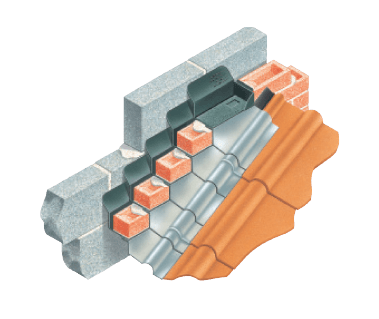
The alternative approach is to use preformed cavitrays with adjustable cavity upstands. The Type X Cavitray is specifically designed to protect stepped and staggered gable abutments and requires no cutting, fabrication or site work prior to building-in. It differs from all other gable abutment trays by incorporating a number of design advantages and its manufacturer Cavity Trays Ltd is the only tray specialist awarded European Technical Approval.

 Preformed cavitrays do not need to be built into the inside skin. The moulded Type X dpc tray is robust and self-supporting, and requires building into the outer skin only. Each tray has a clear cavity compartment and a hinged adjustable cavity upstand that takes up the cavity width encountered.

Compliance and protection of the ‘as built’ cavity width is assured and deviances in skin levels do not affect the tray or its performance. Accordingly the Type X Cavitray can be used in all styles of cavity wall, regardless of the style or type of inner skin construction. To the front of each tray is attached a ready-shaped flashing.

Several flashing material options are available including lead and synthetic (no scrap value attraction). Once the tray has been bedded into position, no further work is required until the roof finish is in place following which the flashings require dressing only.

Trays are now available to service cavity widths up to 200mm and all dimensions of masonry module. A performance warranty accompanies Type X cavitrays for the benefit of Architect Builder and Client. 

Further details within the following new publications available to industry disciplines upon request. 

Protecting the Building Envelope.   vol 22.

The Book of Wise Decisions – Best Practice Guide.   vol 40.


]]>
2011-07-08
Why Protecting Partial Fill Insulation in a Gable is Essentialhttp://www.cavitytrays.com/news/view/55When constructing cavity walls incorporating partial fill insulation, the insulation terminates at plate level. It is common practice to also terminate insulation at plate level across the gable ends rather than extend it up to the roofline. The question arises of whether the top of the insulation where it horizontally crosses each gable end should be protected against water ingress given the expanse of unfilled cavity wall rising above it? Could penetrating water use the top of the partial fill insulation as a bridge towards the inner skin? 

In theory rainwater penetrating an exterior skin of a correctly constructed cavity wall should not get anywhere near the insulation. 

In practice this is not the case. 

Within the triangle of masonry forming the gable are a large number of wall ties. Water will track along a perfectly positioned wall tie until the twist or feature of the tie directs the water to drip off it and fall into the cavity below. Within a 100mm cavity incorporating 50mm partial fill insulation, a conventional tie can discharge water halfway across the cavity. So where that partial fill insulation terminates horizontally across a gable, the top of it is exposed.

Water falling onto an exposed insulation top edge will either pool on it or it will gravitate into it. In both instances with the insulation secured against the inner skin, capillary permeation can result. This can occur where tie and insulation placement is perfect – the problem where ties are not perfectly centred or insulation placement is uneven is more extreme. 

Best Practice is to protect the top of the insulation to prevent this possibility happening.

Using a preformed Cavitray will ensure any water dripping from higher level ties cannot fall onto or into the top of the insulation. Cavity Trays Ltd manufactures several trays suitable for this purpose. 

A popular choice of contractors is the Type CD Cavity Dropcloak. This preformed tray conveniently does not require building into the exterior skin but importantly protects the insulation top and the inner skin.

‘There might be a temptation not to protect the top of partial fill insulation in such an application’ commented a Company spokesman ‘but it is essential as it takes only a couple of ties to cause a damp nuisance and rectification high on a gable wall once the building has been completed is costly’. 

The Type CD Cavity Dropcloak is listed within the new Technical Manual ‘ Protecting the Building Envelope’ the new publication released in May 2011 by Cavity Trays Ltd. 

Cavity Trays Limited Administration Centre Yeovil Somerset BA22 8HU

]]>
2011-06-29
Cavity Wall Openings with a Differencehttp://www.cavitytrays.com/news/view/52Cavity Wall Openings with a difference 

The thermal insulation integrity of window and door openings in cavity walls can be increased by using an approach that combines new and traditional methods. 

One approach is to use two separate lintels, with an L- shaped steel (preferably stainless) providing support of the outer skin and a traditional concrete lintel supporting the inner skin. A polypropylene ready-shaped Type C Cavitray locates onto the L-shaped steel and rises upwardly and across the cavity, providing protection to the entire head of the opening. The tray also extends beyond the opening reveals, to cloak whatever method of reveal closing is deployed. The external masonry is laid onto the Cavitray in the usual manner with Caviweeps in a minimum of two perp joints to provide water evacuation. 

With the inner skin rising off the concrete lintel, there is no direct heat-loss connection between skins and the cavity below the sloping tray is open. It is into this open cavity that a shaped Acoustic Stop and Thermal Barrier can be inserted. This new product from Cavity Trays of Yeovil is available in almost any shape – so the designer and contractor can request a profile to suit their specific build detail. 

Acoustic Stops and Thermal Barriers are enveloped within a coloured dpc polythene sleeve that protects the compressible core consisting of rock-wool insulation. When selecting the infill profile, it is usual to add 15 to 20mm to the width dimension, to promote a full and consistent friction fit when compressed. 

Introducing AST Barriers by Cavity Trays of Yeovil can raise the acoustic and thermal integrity of most support arrangements. When used with approved Type C Cavitrays and Caviweeps, every opening can be scheduled for optimum efficiency. The waste factor can be eliminated.

The opportunity to maximise the thermal and acoustic performance of the opening can also extend to the wall reveals and across at sill level. Cavity Trays offers a range of vertical and horizontal closers that permit compliant closing of the cavity whilst providing the requisite dpc and thermal insulating qualities. The specifier can now select models that additionally offer an acoustic benefit as well as an interfacing facility where partial cavity insulation is being used. 

Whether building traditionally or in timber frame construction, the latest products from Cavity Trays enable the designer and contractor to raise levels of comfort and compliancy. 

If your build detail is unusual, Cavity Trays has a fast-track bespoke service offering attention.                 


See page 72 in the new 2011 Technical Manual: ‘Protecting the Building Envelope’ for details of Acoustic Stops and Thermal Barriers


]]>
2011-06-08
Latest Book of Wise Decisions now availablehttp://www.cavitytrays.com/news/view/50The latest Book of Wise Decisions is now available.

This popular handbook may be downloaded from the website or phone our Helpdesk to order your copy.

Freephone 0800 7311779.

Alternatively complete the enquiry form located under the Brochure Tab on the home page.

]]>
2011-05-26
Acoustic + Thermal + DPC Undersill Trayhttp://www.cavitytrays.com/news/view/49Undersill Cavitray Advantage 

When building-in a stone or precast sill, there is an accompanying requirement to prevent damp ingress, where the sill closes or impinges the cavity. By using a preformed dpc Undersill tray this task can be simplified and at the same time thermal and acoustic qualities can be maximised. 

The Type U Undersill Tray by Cavity Trays of Yeovil is available to suit both solid sills and sills formed on site from brick tile or stone. There are versions for traditional construction and timber frame construction. 

When used for site-formed sills the Type U tray acts as formwork onto which the sill is constructed. The projecting sill front is aligned against the front upturned edge of the tray that acts as a guide. Once the sill has cured this upturned edge is removed along a separating line, leaving a visually unencumbered sill externally but protected and enveloped internally. 

With solid sills the Type U tray encapsulates the sill on three faces and projects downwardly to ensure no tracking inwardly of penetrating water can occur. The cavity faces of both styles of Type U Undersill Tray can incorporate a bonded acoustic and thermal isolation strip that permits contact with the inner leaf without compromising the isolation qualities. 

In the case of timber-frame construction, the tray design additionally includes provision to accommodate some differential movement. This is necessary because of the differing expansion and contraction rates between timber and masonry. As the cavity width grows wider, all sills can be subjected to greater rotational pressures because of the see-saw effect. 

Type U sills from Cavity trays Ltd are available to suit the customers desired sill deflection angle and dimensions. The designer is not limited to popular permutations only offered by alternatives. 

See pages 49, 50, 51 of new 2011/12 Technical Manual for details. 

Cavity Trays Limited Administration Centre Yeovil.

]]>
2011-05-24
New Product Guide 22 Available Now!http://www.cavitytrays.com/news/view/48Our New Technical Manual and Product Guide is available now.

Phone our Helpdesk 0800 7311779 or send us an e-mail from the website to request your copy.

]]>
2011-05-05
New Cavity Closer - Improved Thermal Efficiency for Cavity Widths up to 330mmhttp://www.cavitytrays.com/news/view/47New Cavity Closer 

Improved Thermal Efficiency for Cavity Widths up to 330mm

New triple-layered Cavity Closer. 

Wider cavity widths are addressed using caviclosers from the new Maxi range of Type WCA closers manufactured by Cavity Trays of Yeovil. 

All WCA models (Wide Cavity Applications) close the reveal, act as a vertical dpc and provide thermal zoning between skins. 

The main  body of the WCA Maxi closer is triple-layered.

It consists of a robust 50mm insulating foam core over layered on three sides with a reflective foil on a bubble barrier with a finishing face of heavy duty low conductivity petheleyne.

This multi-layer combination is efficient, benefits a radiance screen and convection separator and promotes thermal contact resistance.

These are the first multi-layered caviclosers for very wide cavities available in the United Kingdom.

Cavity widths up the 330mm accommodated.

Bespoke service  available for unusual sizes. 

Initially available to suit cavity widths up to 330mm, the WCA Maxi range is suitable for use in both traditional and timber frame construction.

The closer may be built in as walls are raised or alternatively introduced at second-fix stage in the build programme.

To secure the closer in place two options are offered:

Conventional tying-in using the accompanying wall ties or direct fixing through the outer edge moulded sections. 

Rather than being moulded together, the Maxi range sides are independent of each other, being friction linked via the insulating core.

This arrangement is more accommodating and recognizes that any axis of movement between the outer and inner skins is more pronounced as the distance between skins becomes greater.

(The co-efficient of expansion of some skin types (such as timber) varies considerably compared with conventional masonry). 

The Type WCA Maxi range may be used to close straight and checked reveals within cavity walls.

For straight reveals the closer is supplied with projecting sections to overlay both inner and outer skins.

For checked reveals the closer is supplied with one of the projecting sections (that normally overlays the outer skin masonry) removed, permitting the closer to terminate against the inner face of that outer skin.

Always specify clearly the type of reveal you are constructing. 

Maxi Range material typical data / analysis: 

    Housing UPVC recycled

    Foam core 0.033W/mK - 0.038W/mK

    Radiant screen on bubble barrier thermal      

    resistance 1.455W/M2K

    Radiance /reflectivity >97%

    Pethyleyne   0.12 W/mK            

    CFC free and zero ODP.

    Ties  polypropleyne low conductivity

Standard 2400mm lengths in cavity widths from 150mm up to  330mm. 

The new WCA Maxi range is available now.

All models promote improved robustness, rigidity and thermal contact resistance.

Please contact our Helpdesk for further information 01935 474769

]]>
2011-04-04
Double Arrestment Benefit of Multi-Opening Cavitrayhttp://www.cavitytrays.com/news/view/42Double Arrestment Benefit of Multi-Opening Cavitray   

Absorption areas of masonry around and above openings must be taken into account where the proximity of those openings is less than 900mm distance. This rule of thumb measurement ensures adequate provision is made to control concentrations of arrested water that could be problematic if allowed to gravitate downwardly in the usual way. 

Water penetrating masonry and then circumventing a circular opening will discharge at the lowest point, (6 o’clock). In the example shown the discharge point is immediately adjacent to and between two arched openings. Both arch openings also discharge water into the same area. Therefore the narrow pier is likely to become exceedingly wet during extended periods of heavy rain. Additionally it must be remembered that all the masonry rising above the openings will also become saturated, and that water will also gravitate and place descend to opening level. 

The masonry area rising immediately above the openings in this example extend to over 20 sq metres – the majority of which will end up heading towards one small dividing pier. 

Cavity Trays Ltd offers the complete solution in the form of a multiple aperture cavitray with an integral arresting barrier. 

The upper part of the cavitray incorporates an arresting barrier that receives the majority of water gravitating within the cavity and masonry. Each end of this arresting section extends outwardly. Thus before the openings level is reached, the water is arrested and discharged via caviweeps located 900mm clear of the openings. 

With the majority of descending water exiting via offset evacuation routes, the circular opening and both arch openings are subjected to minimal volumes. The triple opening cavitray ensures internally each maintains a damp-free status and the pier does not overload and visually discolour externally through water staining and crystalline deposits. 

Cavity Trays of Yeovil is the only cavity trays manufacturer awarded European Technical Approval and operates its bespoke service providing products with product performance liability protection for the benefit of Architect Builder and Client. 

Cavity Trays Limited Administration Centre Yeovil Somerset BA22 8HU               

T: 01935 474769 

F: 01935 428223     

enquiries@cavitytrays.co.uk     

www.cavitytrays.com                                                                                                                             

]]>
2011-01-21
Cavity Barrier Problemhttp://www.cavitytrays.com/news/view/41Cavity Barrier Problem 

Timer Frame construction is one form of construction that calls for the exterior wall cavity to be compartmented. This is a straightforward procedure, and involves the use of sleeved non-combustible insulation located to fully fill the cavity width without interruption at heights that coincide with the floor levels around the building. In the event of a fire, the insulation sleeves prevent fire progressing via the cavity from one floor to the next. 

Vertical barriers are also necessary to provide the same function. Thus every dwelling or living unit is effectively ‘framed’ within its exterior cavity wall, so if fire originates in one dwelling unit it cannot reach its neighbour via the cavity. 

Such devices can address the requirement to provide cavity fire integrity and acoustic measures, but their very presence throws up a new problem. With the cavity fully bridged, what happens to rain that penetrates the exterior skin and gravitates to the level of the cavity barrier? The insulation sleeves that started-off rectangular are intended to end up slightly compressed. This compression coupled with pushing the rectangular barriers down to locate them in the cavity results in the top of the rectangle becoming ‘hollowed’. Penetrating water can pool and reservoir on top of the barrier, sandwiched between outer skin and inner timber skin. 

How does one prevent this happening?  One method is to incorporate a dpc over the barrier, so shaped to direct water away from the inner skin. The dpc will require support at a higher level to hold it in place. There are also sleeved barriers where a surplus of sleeving on one or more sides can be used to act as a dpc. But is there a complication when forming long runs incorporating either of these methods? 

To provide continuity, individual lengths need to lap each other. Lapping methods commonly involve the end of one barrier rising to lap with the other barrier that lowers. Easily done – until you consider the dpc requirement. How do you maintain dpc integrity when the end of a barrier lowers but does not have a stopend? Whether the dpc is separately introduced or is part of the sleeve, ensuring uninterrupted integrity can be exceedingly difficult to actually achieve. Many distorted barrier installations, with questionable laps and questionable continuity can be seen every day on sites.  

What has become apparent is that cavity barriers and stops are being incorporated with a total absence of dpc protection – but there appear to be no problems. 

Similarly, cavity barriers and stops are being incorporated with leaking dpc arrangements, inconsistent dpc arrangements and discontinuous dpc arrangements. But again there appear to be no problems.But appearances can be deceptive. 

When water reservoirs (on top of or in and around a cavity barrier), penetration into the timber frame is prevented only by the timber frame membrane. The membrane physically stops the water decaying the timber inner skin. Currently there appear to be no damp ingress problems and there will be none - until such time the timber frame membrane deteriorates. 

Membrane manufacturers appear to qualify a very limited membrane life when it is directly exposed to elements.  And even the most robust of membranes is reliant on joins – will these last if water pools against them throughout the buildings projected life of sixty years minimum? 

How many housing associations and flat owners have timber frame constructed dwellings where the possibility of eventual decay of the timber frame might be dependent on a membrane not designed for such purposes? 

The alternative is to use a cavity barrier that is shaped.  A sloping top ensures water is always thrown forward – away from the inner skin. No top surface pooling can take place. And a similar sloping bottom permits adjoining lengths to be lapped without the need to raise or lower each length. Thus the fire integrity, the acoustic integrity and the dpc integrity remains uninterrupted. No other barrier provides all these advantages. 

Called the Cavi 60 Type SAF (pronounced ‘safe’) Cavi 60 denotes 60 minutes fire integrity rating and SAF stands for Sloping + Acoustic + Fire.  An optional hard-cap dpc is available. 

Type SAF sloping cavity barriers promote a consistent and functionally compliant build detail and eliminate the risk of wet transference along the barrier top. 

Cavity Trays Limited Administration Centre Yeovil Somerset BA22 8HU               

]]>
2011-01-17
Rendered Walls - Water Exit Routes are Essentialhttp://www.cavitytrays.com/news/view/40Rendered Walls – Water Exit Routes are Essential  

Designers accept that cement rendered surfaces of exterior skins will eventually develop cracks and fissures, irrespective of the render formulation. Accordingly provision should be made to manage the consequence of having cracks and fissures present within exterior rendering during the lifetime of the structure. 

Initially a high alkaline sand and cement rendered surface will shrink. The immediate telltale signs are usually detectable at junctions with window and doorframes. On a daily basis expansion and contraction will also occur, accompanied by a range of temperature fluctuations. To this are added seasonal rain and wind, the combination of which will penetrate the render coat and the masonry skin supporting the render. 

Sand and cement rendered surfaces form part of the building substrate once they have cured and are usually finished with a decorative paint that offers waterproof or water repellent qualities. Conventional paints are classified as low film and are reliant on adhesion to the surface to which they are applied. Thus when the render cracks so does the paint – providing opportunities for water ingress. So whilst the paint film will act as a raincoat over the render, cracks within the film or at its junctions with frames etc can be subjected to considerable water wash running from the surface of the adjacent unbroken film. 

When water that penetrates a rendered surface it can promote four major deficiencies: 

1)       Despite being fully rendered and painted, film detachment and film ballooning can occur. 

2)       Regardless of the render finish, where water pools within dpc’s trays and lintels and cannot escape, damp banding and patching will be visible. Shown here in unpainted render. 

3)       Wet substrate and any substrate affected by internal pooling will deteriorate when freezing temperatures are experienced. Spalling will commonly eventually follow. 

4)       Portland cement materials are susceptible to attack from soluble sulphates within walls where water is prevented from evacuating and the masonry skin cannot dry out. 

There are now discreet caviweeps that are barely visible once installed. They remain in place ready to function whenever volumes permeate the structure. They provide a passive means of escape that is always in place – from when a masonry skin is new and thereafter. Thus the serviceable life of a rendered wall can be extended rather than curtailed by making provision to manage the consequence of having cracks and fissures present within it - and its exterior rendering where present. 

Render deterioration will occur -  it is only a question of when it will occur, It is incorrect to assume a rendered wall is impervious to water penetration during its lifetime. 

Discreet caviweeps be incorporated within rendered walls (right top windows) and brickwork areas (right lower windows) to provide water evacuation routes that are barely visible. 

Further information may be found within Product Guide Volume 21. 

Cavity Trays Limited Administration Centre Yeovil Somerset BA22 8HU               


]]>
2011-01-07
Masonry Skin Levels and DPC’shttp://www.cavitytrays.com/news/view/39Masonry Skin Levels and DPC’s

Pig, Quelk or Gorret?

All three are regional terms used to describe a deviance in level between the two skins of a cavity wall. According to the textbooks the skins should be at the same level, as every three bricks laid on the outer skin should match the height of one block laid on the inner skin. The reality is different. It is common for skins to drift out of level and one can witness the tell-tale signs to correct the levels on the inner skin where lintels are encountered and most prominently at plate level. 

The use of conventional dpc within a cavity wall at changes of level and abutments can be problematic at the best of times. But when skins are out of alignment the position is even worse. If a shaped cloak is used instead but requires building into both skins, it cannot be incorporated correctly if the skins are adrift. 

The photograph captures an example of skins running adrift despite both being constructed of the same sized block work. 

Cavity Trays manufactures preformed cavitrays with adjustable cavity upstands. These are self-supporting so do not require building into the inner skin. Therefore if the levels are adrift it does not affect the functionality of the tray. 

Each upstand is hinged – so it can take up the cavity width encountered as opposed to the cavity width anticipated. It means the cavity is always fully protected. 

Not penetrating the inner skin means laying of that skin can proceed more easily. The bedding courses remain uninterrupted so possible air tightness (or lack of it) is not compromised. 

Cavitrays with adjustable cavity upstands permit the contractor to overcome pigs, quelks and gorrets – or whatever the mason chooses to call the discrepancy! European Technical Approval has been awarded to Cavity Trays Ltd and the Type X cavitray is just one of a range of trays offered with the adjustable tray upstand. 

Cavity Trays Limited Yeovil Somerset BA22 8HU           


]]>
2010-12-10
Level Threshold Deterioration Avoidancehttp://www.cavitytrays.com/news/view/38Level Threshold Deterioration Avoidance  

A recent investigation suggests in excess of 70% of damp problems associated with level thresholds originate through failure to interface correctly with the inner leaf and outer leaf of the cavity wall. 

In traditional building the masonry of the inner skin is dry above its dpc level. The problem is the interfacing of any flooring arrangement terminating at a threshold that is level commonly results in the depth of that arrangement descending below that dpc and that of the adjacent leaf. So doing provides an opportunity for damp transference upwardly and inwardly. 

Additionally the inner skin reveals of any opening must unite the reveal vertical dpc with the dpc at oversite / flooring level and the dpc at threshold level. The correct coming-together of these three elements is essential. 

Level thresholds that fail to address all the above are likely to be problematic in the future.  Whether the abutting floor is constructed of timber or concrete, eventually any damp ingress will affect the structure, its surface and its decorative finish. 

To remove such risk one can build in a threshold dpc.

The Type LTT (Level Threshold Tray) by Cavity Trays of Yeovil may be introduced onto the inner skin during construction. It can also be applied to the exterior skin so both are enveloped. The function of the Type LTT is to act as an extended hat that covers the top and the sides on the masonry. So doing permits the floor arrangement to come into contact with the skin at threshold level. But because the masonry is enveloped, dampness cannot translocate.

Where the Type LTT meets the reveal masonry either side of the opening, it does not terminate but continues upwardly and around both faces of the reveal skin, extending into the actual cavity. Thus all integration  (vertical dpc/closer and oversite dpc) uniting at this juncture do so benefitting isolation from dampness within the lower level masonry. 

If moisture is not isolated, dampness and calcium sulphate from building material can be translocated and can subsequently manifest on the wall surface as efflorescence. Whilst hygroscopic salts in plaster are not a significant structural issue, any dampness will catalise eventual deterioration.  

Any actual moisture scource will translocate salts - nitrate and combinations of chloride salt being typical.

Where such ingress is at flooring level and the reveals,  rapid deterioration is enevitable. The gravimetric moisture content of building materials varies, dictated by differences in density and a materials ability to contain and bind water hygroscopically. BRE Digest 245 provides guidance and the formulae for determining moisture content. Defined as the total gravimetric moisture content less hygroscopic water, it provides a useful indicator of water available supporting deterioration and biodegradation processes. 

The British Standard released in December 2009 (BS 8102) provides the Code of Practice regarding protection from water from the ground. 

The Type LTT by Cavity Trays of Yeovil promotes a route to compliance. In isolating one of the areas most susceptible to damp transference, the Type LTT permits abutting flooring, abutting insulation and dpc’s / membranes to continue over an inside skin and converge with an exterior skin that itself is isolated from dampness at the point of convergence. 

Suggested reading: 

Cavity Trays Product Guide number 21.

BRE 245

British Standard 8102.

]]>
2010-12-02
Multicourse Cavitrays - Protection Compatibilityhttp://www.cavitytrays.com/news/view/37Multicourse Cavitrays  

Protection Compatibility 

Preformed cavity trays running parallel with the roofline are incorporated in the masonry where a gable abuts a cavity wall.In the case of brickwork, standard 75mm coursed trays are used. But where the walling material is of different coursing, different depth or built against a backing block, an alternative approach is required. 

Multicourse cavitrays are manufactured by Cavity Trays of Yeovil and are available in an infinite combination of dimensions to suit the walling material in which the gable is being built. 

Trays are first sized to match the ‘course’ height.The cavitray layout must provide continuous unbroken protection throughout the slope.The finished installation is best described as a dpc staircase.The tray base being the stair tread and the tray end upstand being the riser.Masonry above the tray line will be exposed to the weather but the staircase of trays prevents dampness from continuing permeation downwardly. 

The depth of each tray accommodates the entire outer skin of masonry.This includes any backing block against which the outer skin is being raised.Once the tray base reaches an appropriate position in the cavity it rises upwardly, to provide protection across the cavity width.This upstand is actually hinged so it can span the ‘as built’ cavity width as opposed to the ‘as intended’. 

As the flashing is already attached to every tray, the usual task of raking out joints and cutting/fitting separate flashings is eliminated.Having the flashings attached also means there is no need to return to point-in afterwards. 

Cavity Trays will schedule all requirements and provide the ‘complete solution’ for all abutments. Multicourse cavitrays benefit a performance warranty and are supplied labelled and ready for immediate installation by the mason. 

Cavity Trays Limited Administration Centre Yeovil Somerset BA22 8HU.              


]]>
2010-11-19
Cavity Wall Water Evacuation is Essentialhttp://www.cavitytrays.com/news/view/35Cavity Wall Water Evacuation is Essential!

Failure to provide adequate means of water evacuation from a cavity will causes three major considerations: 

Visually

External discolouration, salt emission and eventual permanent staining will eventually blemish the appearance of the structure. 

Internally

If sufficient water is trapped and reservoirs within the cavity, it will permeate inwardly. Water does not discriminate and if it cannot evacuate outwardly easily, it will find alternative routes. 

Structurally

The masonry and mortar joints will suffer premature deterioration. Spalling will occur when trapped water freezes and expands. Masonry cracking, loosening and delaminating will eventually result. 

The need to drain cavity walls is not limited to just window and door heads. Changes of level, roofing intersections and ringbeams are just three further examples of construction details where functionality is reliant on water being adequately evacuated. 

Evacuation can be achieved using preformed caviweeps. Caviweeps ensure water is not trapped within the structure but can exit speedily.   

Five versions of caviweep in many different colours are manufactured by Cavity Trays of Yeovil.  This permits the Architect to select the most appropriate caviweep to suit the construction. Options include caviweeps with insect screening, discreet external appearance, integral wind baffles, to suit all styles of mortar, masonry etc. There are even versions to suit masonry with drafted margins or restricted bed and perp joints as encountered with ashlar walling. 

Once an external masonry leaf has become saturated and cannot absorb further rain, it acts as a conveyance sponge allowing up to 2.25 litres of water per hour can pass through every square metre of it during ongoing rain. Whilst some styles of masonry are more resilient to ingress, wall design must always anticipate the most extreme exposure possibilities, so evacuation provision is always adequate. Cavity Trays of Yeovil will be pleased to assist the optimisation of water evacuation provision upon request. 

Where caviweeps are used with cavitrays manufactured by Cavity Trays of Yeovil, the combination benefits a performance warranty for the advantage of Architect Builder and Client. 

Cavity Trays of Yeovil is the only cavity tray manufacturer awarded European Technical Approval. 

Further Reading in Product Guide 21  

Type W Caviweep

Euroweep

Beak Caviweep

Small Extendable Caviweep

Pyramid Weep 

Cavity Trays Limited

Administration Centre

Yeovil Somerset BA22 8HU               

T: 01935 474769 

F: 01935 428223    


]]>
2010-11-12
Continuity with Corbel Cavitrayhttp://www.cavitytrays.com/news/view/34Continuity with Corbel Cavitray 

Where corbel dimensions result in the cavity being encroached or breached, a different approach is required to ensure the corbel cannot act as a bridge via which penetrating dampness can reach the inside skin.  

A preformed corbel cavitray that envelops the hidden faces of the corbel is manufactured to order by Cavity Trays of Yeovil.  

The corbel cavitray prevents dampness from permeating inwardly and with thermal insulation bonded on those faces that run parallel with the outside skin, it also addresses cold bridging.  

The envelopment can incorporate an upward angled section on the top of the corbel surround (to guard against water tracking) where masonry exists between it and its position in relation to the roofline. 

The corbel cavitray is manufactured from petheleyne dpc and the phenolic insulation has a ‘k’ value of 0.029W/mK. Use of corbel cavitrays can improve the thermal behaviour at the point of incorporation and ensure the detail is unable to support water ingress. Cavity Trays Ltd is pleased to schedule and quote for your requirements upon receipt of drawings.  

Cavity Trays Limited Administration Centre Yeovil  Somerset BA22 8HU

T: 01935 474769  

F: 01935 428223 

enquiries@cavitytrays.co.uk 

www.cavitytrays.com           


]]>
2010-10-29
Static Cavity Walls Can Move - Beware DPC Slip Planeshttp://www.cavitytrays.com/news/view/33Static Cavity Walls Can Move - Beware DPC Slip Planes 

Parapet cavity walls behave differently because both faces are exposed.Such dual exposure dictates the protection against damp penetration takes into consideration more variable elements than are normally encountered. And if the parapet is curved, the behaviour of the masonry itself can be more problematic if certain aspects are ignored. 

When a traditionally constructed parapet wall becomes saturated with rain and in extremes of heat and cold, expansion of the masonry can prejudice the masonry structural continuity.When this occurs the DPC bedding course in a parapet offers the least line of resistance and acts as a slip-plane, so movement at DPC level in the outer and inner skins is commonly witnessed. 

Where the amount of expansion is not fully compensated by contraction, progressive movement over the years will occur mainly as a result of ratcheting.  (Where the expansion movement is not fully matched by the retraction movement and masonry above and below the DPC progressively moves out of alignment). This is easily identified initially by witness lines and eventually by horizontal cracking along the courses in which the parapet DPC has been supported. 

Curved parapets can accentuate the problem especially if the curve is between two resilient structural points.

Thrust direction can then move at 90º to the arc and a radius eyebrow ledge can result.

Such movement is commonly accompanied with coping dislodgement where coping pinching occurs. 

The British Standard detail depicts an outward stepping dpc supported in both the inner and outer skins of the parapet wall.This is logical in terms of functionality, but it means the entire parapet masonry above the dpc is separated from the masonry below the dpc. Not the ideal structural arrangement for a highly exposed wall at the top of a building. 

However, by using a preformed Type P parapet cavitray that is self-supporting and requires building into one skin only, the outward stepping profile is achieved but the opposite masonry skin can remain uninterrupted.As a consequence the solidity and structural integrity of the wall build is considerably improved.

As with any wall, in long runs and especially when constructing a curved parapet, expansion provision is necessary in the form of expansion joints. 

A spokesman for Cavity Trays of Yeovil explained: ‘Originally the British Standard showed an inward stepping dpc rather than an outward one and initially parapet walls built to that detail functioned correctly. But it takes a few years before parapet cracking is apparent, and eventually water would permeate the outer skin along the dpc bedding joint and track inwardly on the underside of that inward stepping dpc. As soon as that tracking reached the inner skin, the damp problem became visible. 

Our approach was the opposite.

We designed an outward stepping arrangement - the concept subsequently adopted within the latest British Standard. However, by limiting our design to being built into one skin only, benefits improved structural integrity. 

Parapet design must embrace the coping also, as coping joints eventually weather and fissures provide an entry opportunity for water.

Parapet walls need not be problematic.

The right specification ensures a correctly protected structure and one in which the structural continuity is not diminished because of dpc slip planes.  

END.


]]>
2010-10-22
Why Water Penetration Around Some Arches is 80% Higherhttp://www.cavitytrays.com/news/view/32Why Water Penetration Around Some Arches is 80% Higher

Water penetration around some styles of arch openings can commonly be up to 80% higher than water penetration around others. The difference depends on two main factors, the arch style and the arch height. As the rise (calculated as the vertical distance between intrados (springing) level and head level) increases so does the masonry absorption area. The actual style of the arch also affects the absorption area. As the absorption area increases, so does the opportunity of entry into the wall of penetrating water. 

This is best demonstrated by comparing a French arch that is relatively flat with a Trefoil, Semi-Circular or Gothic arch, all of which proportionally rise considerably above intrados level. Rain penetrating masonry above the arch curve will gravitate around the cavity tray that protects the arch and then continue its downward path in and on the external masonry skin until it reaches the base of the opening. Whilst making its downward journey it is joined by additional penetrating rain entering via the masonry to either side of the arch. Thus the need to accommodate the most severe of potential permeation into the masonry must be provided. 

This is achieved on arch openings with the use of Type BA cavitrays.BA stands for Barrier Arch and all styles of arch opening can be accommodated. Barrier Arches are manufactured in polypropylene and pethylene solid dpc. 

Made on a bespoke basis, Barrier Arches can take into account and can operate with other tray types to address conditions on site.For instance where there is a large expanse of masonry rising above an arch, Arresting Barriers are sometimes introduced at a higher level to reduce the volume of water descending in the cavity before the arch is encountered. Water does not discriminate, and a systematic approach ensures water control, water arrestment and water evacuation adequately addresses potential extremes of weather. 

It is prudent to remove penetrating water from within a wall and this is achieved using Caviweeps that provide defined water evacuation routes. If masonry remains wet for long periods the presence of soluble sulphates from clay bricks can initiate sulphate attack on the mortar joints and other Portland cement materials. Type BA Barrier Arch Cavitrays and Arresting Barriers are supplied with Caviweeps, promoting best practice. 

Details of the bespoke service offered by Cavity Trays of Yeovil may be found on its website and in product manual number 21.

END.


END

]]>
2010-10-15
Cold Bridging and Dampness around Masonry Cillshttp://www.cavitytrays.com/news/view/31Cold Bridging and Dampness around Masonry Cills

Masonry cills create an arrangement wherein the proximity between inner and outer skins of a cavity wall are brought closer together. In some instances they are bridged. Regardless of whether the cill is stone, concrete, tile or brick, provision must be incorporated to prevent damp transference and ideally to maximise thermal isolation. The use of Type U undercill trays can provide this status, and at the same time assist build speed. 

When used with composite / site formed cills of brick or tile, the Type U Type U undercill tray is supplied to suit the desired profile required and once bedded in position acts as integral formwork into which the cill materials can be laid. The front of the Type U projects forward of the masonry face and has a front upturned lip. This acts as an alignment guide for the mason, and promotes a uniform finish. The undercill tray has stopends to prevent end water discharge and promote integration with reveal closers. Once the cill has cured a grooved detachment line permits the front of the tray to be removed leaving just the cill projecting. The remainder of the tray remains insitu, acting as a damp course barrier so dampness cannot track inwardly. 

Insulation can be bonded onto the back upstand of Type U trays and used to great advantage to isolate and thus reduce thermal cold bridging. The maximising of thermal benefit can be combined with the benefit of a preformed damp control. 

Where solid cills are used, the Type U is supplied to fulfil the same function encapsulating the back, bottom and ends of the cill but without having to provide alignment and formwork accompaniment. 

A spokesman for Cavity Trays of Yeovil commented: ‘Roll dpc cannot provide the uniform and consistent three-dimensional qualities demanded to provide the ideal damp prevention around a cill. Using a preformed undercill tray does, plus accompanying insulation opportunities. Importantly, use of an undercill tray permits reveal closing to be interfaced correctly. In so doing directional external water-wash that can result in the majority of rain running down a window to reservoir on a cill/reveal external corner need not be problematic. Internally around the cill and in the adjacent cavity areas, penetrating water is arrested so the inner skin remains dry.’ 

Type U undercill trays are manufactured to clients required profiles and can be supplied separately or as part of cavity wall opening packages. 

Further information may be found within Product Guide volume 21. If you have a bespoke requirement, please contact us. We will be delighted to advise and submit proposals.

END.

]]>
2010-10-08
An Easier and More Effective Traditional Build Detailhttp://www.cavitytrays.com/news/view/30An Easier and More Effective Traditional Build

Detail (Better damp protection + improved insulation opportunity) 

Development schemes replicating past construction styles demand an innovative approach to damp protection over the window heads. Cavity Trays of Yeovil has produced an option for the builder that provides warranted modern damp protection in the form of ready-shaped cavitrays that can be incorporated without being externally visible. 

Timber lintels over external openings are currently popular where a traditional cottage style elevation is sought. The innovative approach is to build in the timber lintel so it is purely a visual element, and provide support via a steel lintel immediately above the timber.

The steel lintel is of a longer length than the timber under it, so it bears and all loads subsequently bear on masonry. No structural demands are made on the timber under the steel that adopts a visual presence only.

The arrangement also provides opportunity to introduce enhanced thermal insulation adjacent to the window head, so the opening can benefit higher overall thermal integrity. (Provided using sleeved insulation barriers also from Cavity Trays of Yeovil). 

In such applications damp protection in the form of Type C cavitrays is provided at two levels. A Type C cavitray bedded on the steel lintel arrests most of the penetrating rain. Complete with stopends, this cavitray discharges the arrested water via discreet caviweeps incorporated towards either end the tray – away from the window opening. At a lower level under the timber is located a second smaller cavitray. This provides protection against water tracking inwardly in and around the timber lintel, acknowledging that eventually shrinking and settlement will occur where timber and masonry abut. 

A Company spokesman commented: ‘We recommend the two level – two cavitray approach. It overcomes a common weakness that manifests if one positions the timber directly on a steel lintel. So doing results in all penetrating water being routed behind the timber where the water can pool as well as sponsor rapid decay. It also means all loading effectively rests on the timber first – not an ideal arrangement given the circumstances. 

Our two level – two cavitray approach avoids this hazard and no structural demand is made on the timber. And in the event the timber should ever require replacement, it can be done without affecting any load bearing aspects of the structure.’

Type C Cavitrays are available in profiles and dimensions to suit all opening styles. Whether the requirement is traditional, modern or classical, there are preformed trays to protect the detail.

Further information may be found within Product Guide volume 21. If you have a bespoke requirement, please contact us. We will be delighted to advise and submit proposals.


]]>
2010-10-01
Circular Cavitrays up to 3 Metreshttp://www.cavitytrays.com/news/view/29Circular Cavitrays up to 3 Metres

Increased manufacturing investment and capability within Cavity Trays of Yeovil means from 4th January 2011 its Type K Circular Cavitray will be available to suit circular openings up to 3 metres in diameter. 

A Company spokesman commented that most circular windows are in the popular 450mm to 900mm range. However, the diameter of circular openings for industrial applications can be up to three metres and regardless of whether of aesthetic or functional purpose, all require damp protection where they punctuate the cavity wall. 

This is provided by the Type K Cavitray that envelops the circular frame promoting 360-degree protection. The Cavitray actually sleeves the frame outside edge so there is no direct contact with the damp masonry. The main body of the Type K rises upwardly within the cavity ensuring separation between inner and outer skin. When insulation is also required, a thermal collar that ‘rings’ the opening provides this. 

‘Whilst such openings are commonly called bulls eyes, not all of them are circular’ commented the spokesman. ‘We are regularly required to produce elliptical models and sometimes designs require an arrangement of two or more interconnecting sections.’ 

Water that penetrates masonry above and around a circular or elliptical opening eventually gravitates and discharges at the bottom of the opening, having tracked around the protected frame. ‘That is why we mould in a protective skirt’ commented the spokesman, ‘to ensure all such water is controlled and cannot track inwardly. More water accumulates at the bottom of a circular opening than at the top – exactly the opposite to what happens over openings with horizontal heads. The choice of masonry also influences water behaviour. Perforated bricks for example can act as multiple vertical conduits via which penetrating water can gravitate more speedily. An increase of 35%+ in the speed at which water permeates is not unusual’. 

Type K circular Cavitrays for popular sizes are normally available from stock.

Sizes up to 3 metres diameter are manufactured to order by the bespoke division of Cavity Trays of Yeovil.

The lead-time for such bespoke requirements is expected to halve once the unit is operational. 

Production unit operational from 4th January 2011. 

Cavity Trays of Yeovil

]]>
2010-09-24
Rain Amplification with Curved Cavity Wallshttp://www.cavitytrays.com/news/view/28Rain Amplification with Curved Cavity Walls

 Cavitrays Overcome Problem   

Cavity Trays of Yeovil has announced an increase in demand for trays to suit curved (on plan) cavity walls. The Company currently manufactures curved cavitrays for use over windows, horizontal and sloping intersections and changes of level.

Curved trays for curved walls present the designer with many additional design considerations compared with standard flat surfaced / straight walls.

A good example is where a pitched roof abuts a concave or convex cavity wall. The pitch of the abutting roof may be constant, but where the roof actually strikes the wall the angle of intersection changes throughout the slope. For a brief moment at the commencement of the slope the intersection may be horizontal, but as the wall turns the angle changes and those changes continue until the top of the roof. 

The question of how to best protect the structure against wet penetration and externally flash the intersection is answered by using preformed curved cavitrays. Each tray is individually and compositely computer calculated to take into account the arc of the wall, the masonry coursing and its position up the slope. Each tray is then numbered so the builder can literally start laying by numbers – with assured interfacing and compatibility. 

Cavity Trays Ltd also takes into account how the wall (and its flashings) will behave during storm conditions. Compared with a straight wall, the effect of a concave or convex arc is to accentuate the water-wash being blown across the curved surface. Provision must be made for weathering functionality into the direction of each flashing lap as well as with the direction of the lap. This is because the concentration (build-up) of water-wash traversing a sq metre of curved surface can (subject to the radius of the arc) increase by up to 200%. This is when compared with a flat surface where the plane does not promote deflection (windscreen principle) in any direction other than downwardly by gravitation. 

Intersections abutting concave walls are likely to be subjected to more extreme demands compared with convex walls. This is because water can accumulate and be ‘focussed’ to a greater extent within a dished surface whereas it will discharge off (around) a surface providing the opposite deflection. 

Cavity Trays calculates this status, and each flashing supplied of each individual Cavitray provides appropriate cover and appropriate lap. Conventional site-applied running flashings cannot match the performance of the shaped lapped flashings fitted to Cavitrays. The Cavitray lapping arrangement provides a second layer of water arrestment and the flashing anchoring within a bosem jaw guards against capillary ingress. 

The use of recessed pointing on any curved masonry is best avoided as it can act as a conduit along the wall surface. Flush pointing is favoured as it offers a satisfactory uninterrupted finish and promotes a solidity of masonry and tray bond. In terms of cost effectiveness, flush pointing also eliminates the need for further attention from the mason. Only the tray flashings require dressing later in the build programme. 

Finally, the water penetration capacity of a wall is directly influenced by the type and composition of masonry used. Bricks or similar masonry units of low absorbency will act like a raincoat initially causing water to run off / wash over the adjoining masonry. In identical weather conditions, bricks or similar masonry units with high water absorption will soak up a considerable volume of water like a sponge, initially reducing the amount being passed on as a ‘wash’ onto adjacent masonry. Once saturation of masonry has occurred, both types will behave in the same manner. This behaviour underlines the need to design all intersections and junctions to accommodate the most extreme scenario - the eventual extent of exterior water-wash as well as the maximum volume of water capable of permeating through the masonry. 

Cavity Trays of Yeovil operates concept design and advisory services for which no charge is made. The Company is the only cavity tray manufacturer awarded European Technical Approval. 

Product information sources: 

Cavity Trays of Yeovil Curved Type X Approved Cavitrays for sloping roof abutments.

Cavity Trays of Yeovil Curved Type C Approved Cavitrays for window and door openings.

Cavity Trays of Yeovil Curved Type G Approved Cavitrays for horizontal intersections.

Cavity Trays of Yeovil Approved Caviweeps.

Cavity Trays of Yeovil Current Technical Manual: Product Guide Volume 21.

]]>
2010-09-17
Ventilator Offers More Choice - and Cost Savingshttp://www.cavitytrays.com/news/view/27Ventilator Offers More Choice - and Cost Savings.  

Fitting ventilators into an existing soffit can be made easier and more cost effective using the Circular Soffit Ventilator by Cavity Trays of Yeovil, which the Company claims is different.

The Type CSV Circular Soffit Ventilator has a higher air throughput than most of a similar size.

This is achieved by having louvers rather than a grille.

These provide insect resistance but promote greater opportunity for the free flow of air. 

 A greater flow means you need fit less of the Type CSV along the soffit to provide the requisite levels of roof ventilation.

So there can be savings in cost and labour. 

The louvers also provide another benefit.

When fitted with them sloping inwardly the ventilator is difficult to detect as the louvers camouflage the apertures so their colour merges with that of the soffit.

Turn the ventilator 180 degrees and the soffit has a punctuated appearance as the aperture slots can be seen. 

Cavity Trays has now launched the Type CSV in handy display packs that are ideal for merchant and builder.

Each pack contains 50 Type CSV. 

For more details contact the Sales Department (Ventilation Products) at Cavity Trays of Yeovil BA22 8HU.


]]>
2010-09-10
Expanding Bespoke Service in Cavitrays and Caviclosershttp://www.cavitytrays.com/news/view/26Expanding Bespoke Service in Cavitrays and Caviclosers

When the recently enlarged bespoke production unit at Cavity Trays of Yeovil was asked to design bespoke

damp protection for openings on a large apartment scheme, it came up with a cost-effective, thermally efficient

and speedy to install proposal.

 The construction of blue lias with projecting hamstone features required horizontal dpc protection across

the window head that also extended downwardly to provide insulated reveal protection.

The hamstone was thus separated from but linked with the outer and inner masonry skins.

At the bottom of the opening the insulated reveal protection interfaced with a sill cavitray, so that every

opening was effectively ‘framed’ with an uninterrupted arrangement.

Bonded to the rear face of each protective frame was phenolic insulation to provide thermal zoning around

the entire opening, to more than satisfy the calculated regulation levels. 

One of the benefits of the bespoke design was that protection could be standardised in profile,

yet applied on openings of different and variable dimensions.

This meant the masons could adhere to an uninterrupted build sequence.

Each opening could be packaged and numbered, to simplify stock control.

The waste factor encountered with site-fabricated approaches could be eliminated and installation speed maximised.

Water arrested by bespoke cavitrays is discharged via discreet caviweeps.

These cannot be detected in the stone face – unless one looks very closely. 

Caviweep evacuation rate is influenced by the absorption area (extent of continuous masonry) rising above each opening.

In such stonework the anticipated flow usually remains relatively constant during the initial years but commonly rises

after year five as fissures and fine settlement cracks (often at junctions between dissimilar materials) contribute to water

ingress opportunities. 

Using preformed Cavitrays, Caviclosers and Caviweeps in standard or bespoke form provides designer and contractor

with an assured and warranted solution for every opening within a cavity wall.

END.


]]>
2010-09-03
Cavity Trays increases fire integrity of hatcheshttp://www.cavitytrays.com/news/view/24One Hours Fire Integrity - Free!

Cavity Trays of Yeovil has announced the withdrawal of its’ fire rated loft hatch with a fire integrity rating of one hour.

In its place Cavity Trays is offering a high performance two-hour rated version, at no additional cost.

‘Whilst a one hour rated hatch is adequate in most applications, we believe this cost-attractive higher specification model will appeal’ commented a Company spokesman. ‘The hatch has been independently tested and has achieved a two-hour rating, but is being offered at exactly the same price as versions offering half the protection’.

Providing additional protection is not new to the Yeovil-based Company.

It recently upgraded many of its acoustic and fire-rated caviclosers, and now offers many styles with integrity ratings of up to four hours.

Similarly it has altered the shape of its horizontal cavity sock/closer that is manufactured with sloping upper and lower surfaces.

Unlike conventional rectangular cavity socks, the Type SAF version from Cavity Trays cannot act as a bridge for water to reach an inner skin, as the sloping surface always directs water forward.

‘It promotes a more reliable build detail and overcomes many installation shortcomings’ commented its spokesman. 

Details of Cavity Trays acoustic and fire rated products are available upon request.


]]>
2010-08-24
Masonry Protection Package Eliminates Construction Problemshttp://www.cavitytrays.com/news/view/23Cavity wall openings must appropriately interface lintel /opening protection with vertical reveal-closing protection. 

The construction arrangement need not be problematic where the external skin style and the frame setback are non-standard. 

What is essential is that the relationship between both is correctly formed and provision is made for water evacuation. 

With the growing use of composite (faced brick effect) lintels and deeper masonry reveal arrangements, the benefit of ‘Opening Protection Packages’ is highlighted. 

Cavity Trays of Yeovil is now supplying Opening Protection Packages, offering preformed solutions that not only provide an assured detail

but also reduce wastage and eliminate construction fabrication error.

Type C Cavitrays are preformed protective trays for use with all styles of lintel support.  

As well as being ready-shaped they are supplied cut to length. 

Thus the usual necessity of having to cut damp course, arrange it and then support it within both skins (to provide shape) are eliminated.

Preformed also means there is no danger of sagging or distortion – common with soft roll dpc. 

Trays can be instantly incorporated and a consistent detail established every time. 

The ends of each tray project and oversail the tops of the vertical Cavicloser built in to close, insulate and act as a damp course between outer and inner skins. 

In the example photograph the oversail was extended to terminate in excess of 225mm beyond the masonry opening.

This overcame the problem of water evacuation not being possible through the faced composite lintel and permitted the use of discreet Caviweeps within the perp joints away from the masonry opening. 

Visually the use of preformed Cavitrays, Caviclosers and Caviweeps extends the design options available to the Architect and Contractor whilst promoting functionality without sacrificing aesthetics. 

Type C Cavitrays / profiles are available to suit standard and non-standard opening arrangements. 

Caviclosers are available to suit walls of all styles with cavity widths up to 200mm. 

Six styles of Caviweep/Cavivent are offered to harmonise with the masonry and /or mortar. 

Opening Protection Packages do exactly what they say. And the elimination of waste is accompanied with accurate costing and accurate scheduling. 

CAVITY TRAYS LTD

August 2010. 

END

]]>
2010-08-06
Good News! The New Part L and NHBC Conservatory Constructionhttp://www.cavitytrays.com/news/view/21Good news is contained in the new Building Regulations Approved Documents L1A and L1B that deal with the conservation of fuel and power in new buildings and existing buildings.


L1A and L1B are very similar, with L1B being the more demanding. Anyone constructing a conservatory or porch that is attached to a dwelling must construct it in a manner that complies with the new energy efficiency provisions. October 1st 2010 is the date this comes into force.


Exemption (of the energy efficiency provisions) will only be granted where:


The conservatory or porch is at ground level only.

It has a floor area of less than 30m².

The doors and windows in the wall to which the conservatory is attached are retained, or if removed they are replaced with substitute walls, windows or doors that meet the new energy efficiency requirements.

The heating system of the dwelling must not extend into the conservatory.


If the conservatory fails to meet all four of the above conditions, it is deemed not to be exempt and must comply with the relevant energy efficiency requirements (4.8 and 4.9).

And if it is not exempt, it must be treated as a conventional extension in which case all applicable Building Regulations apply.


Under Building Regulations, the cavity wall below the roof level of the new conservatory must not suffer damp penetration. But with the outside skin above the roofline exposed to rain, dampness readily gravitates downwardly below the roofline and into the conservatory. Just flashing the intersection is not sufficient.


The remedy and compliance is achieved using preformed cavity trays that are inserted into the masonry just above the roof intersection. With versions to suit horizontal and sloping abutting roofs*, all styles of conservatories can be protected from dampness. 


‘At last there is an official line to take regarding cavity trays and conservatories’ advised a spokesman of Cavity Trays of Yeovil. ‘As a rule of thumb trays will be necessary, unless the addition is exempt. Conservatories have departed from the original dictionary definition of a glazed housing for plants and are now commonly used as extensions of the living space, so it makes sense to regularise the construction integrity’.


It is interesting to note that the NHBC advocated some years ago that trays should be fitted above conservatory roof intersections. Now its view is reinforced and from October 2010 it is thought over 90% of all conservatory proposals will be non-exempt, and thus will have to be constructed to the new Building Regulation standards.


‘Regulations are guiding this change which should result in conservatory contractors offering the same standard and compliant scope of build where the roofs attach to the original structure’


* Type E cavitrays for horizontal intersections.

* Type X cavitrays for sloping intersections.


Both manufactured by Cavity Trays of Yeovil from which a brochure dealing with the compliant interfacing of conservatories is available upon request.

]]>
2010-06-15
Construction Compliant Cavitrayshttp://www.cavitytrays.com/news/view/20Building to Regulation Requirements 

This month Cavity Trays Ltd is releasing a new Product Guide – number 21.

With over 91 data changes, 145 text changes and additional products included in the guide for the first time, it is claimed to be essential reading for all disciplines involved in the design and construction field.

The A4 sized Product Guide 21 is printed in full colour and addresses compliant construction of the building envelope. Damp courses, flashings, cavity trays, weeps, thermal, acoustic and fire integrity rated products from ground to roof level are listed together with design considerations. 

Cavity Trays Ltd is the only cavity tray manufacturer awarded European Technical Approval and its approved products are accompanied with product performance liability protection for the benefit of Architect Builder and Client. 

Product Guide 21 provides the latest information and is available upon request now. At the same time the Company is accepting advance reservations for Guide 22 that is scheduled for release in January 2011 and will contain a new range of energy-efficient products that are currently undergoing appraisal and testing. 

The current list of publications from Cavity Trays Ltd is:


1.     The New Cavity Tray Product Guide 21

       Cavitrays, dampcourses, flashings, membranes etc (210)


2.     Closing Cavity Walls 

      Thermal, acoustic and fire integrity rated closers and barriers (19)


3.     Ventilation

       Products for roofs walls and floors (19/107)


4.     Gable Abutments

      Brochure focusing on stepped and staggered gable protection (21)


5.     Conservatory Construction

      The use of trays to satisfy Building Regulations (J08)


6.      The Book of Wise Decisions

Handy pocket-sized book containing concise entries of most products (2010)


Cavity Trays Ltd is the longest established in its specialised field.

Issued by the Marketing Department,

Cavity Trays Ltd.  BA22 8HU.

May 2010

Order your copy of Product Guide 21 and at the same time reserve your copy of Guide 22 available January 2011

]]>
2010-05-04
Cavity Trays approved by GreenSpechttp://www.cavitytrays.com/news/view/17Cavity Trays Ltd approved by GreenSpec and are now listed on the GreenSpec approved products website.

GreenSpec have a rigorous product evaluation and selection process so we are naturally very pleased with this acknowledgement.


]]>
2010-04-01
SIPS panel profiled DPC's - New Producthttp://www.cavitytrays.com/news/view/15SIPS Panel DPC Profiles

Timber Frame (DPC) Profiles


Often a detail is called-for within a contract that it is difficult to reproduce on site. This has prompted Cavity Trays Ltd to release a new range of dampcourses that are ready-shaped to tackle everyday construction needs encountered when building using timber frame and SIP’s methods.

The most popular of the DPC Profiles is designed for use under sole plates. Construction standards demand dpc’s are incorporated below all timber frame sole plates of ground floor walls. Furthermore, in addressing the requirements for air tightness, Robust Details calls for the dpc to turn up and lap with a vapour control layer. Using traditional dpc to create such an arrangement can be difficult. Traditional dpc can also distort,  be damaged, or progressively sag  whilst construction is taking place.

Solution

DPC Profiles are accurately dimensioned semi-rigid shaped dpc’s that permit the installer to establish consistent dpc protection around the base of timber-framed and SIP walls.

Laid and lapped under the sole plate, the profiles rise vertically to protect the inner face of the plate. (Depicted in NHBC Standards 6.2). Profiles are also available that extend inwardly. In so doing the oversite membrane can benefit both horizontal and vertical interfacing. 

DPC Profiles will not extrude under load and functionality is unaffected by normal packing / point loading. Additional protective rise can be specified where a double soleplate is used. Internal and external angles are similarly preformed. Bespoke profiles are available in addition to the standard profiles. 

DPC Profiles can be used effectively to address Robust Details (6.11 to 6.15 inclusive) and NHBC (6.2) requirements.  

  • Satisfies NHBC / Robust Details requirement
  • Will not extrude or seep under load
  • Close fits timber – no sagging or damage
  • Consistent quality of build


]]>
2010-03-01
New Circular Louvered Vent for existing wallshttp://www.cavitytrays.com/news/view/13New after-fit drill and vent used to ventilate an existing cavity wall.

The CLV lovered vent can be introduced when the wet trades have finished. It differs from most circular ventilators as it has an airflow aperture rating of 2100mm2.

The Type CLV - Circular Lovered Ventilator is available in a range of colours to suit popular masonry colours. Terracotta, Beige, Brown, White and Black.

Data:

Polypropylene.

Size 79/70 x 15mm - Requires 70mm hole.

Louvres deflect driving rain and provide insect screening.

Integral location grips.

Featured in the latest 2010 Book of Wise Decisions Pocket Guide

]]>
2010-02-19
Cavity Trays joins The Green Organisationhttp://www.cavitytrays.com/news/view/14Cavity Trays Ltd has been awarded three star membership of The Green Organisation, one of the worlds leading environment groups.

Cavity Trays is committed to continually reducing the environmental impact of our operations, including the manufacture and use of our products.

]]>
2010-02-19
New Product - Level Threshold Trayhttp://www.cavitytrays.com/news/view/8Type LTT LEVEL THRESHOLD TRAY (Threshold Isolation DPC)

Introduction  

The level threshold is an everyday feature in construction that can be problematic. It is not just marrying of the external and internal levels that can prove challenging, It is doing so in a manner that protects against wetness permeating and permits a functional interfacing with the method of reveal closing / insulation and the oversite membrane.

There is now a new product manufactured specifically for this purpose. It regularises this specific area of construction. It permits internal and external floor levels to interface at an opening within a cavity wall. 

Cavity Trays of Yeovil has come up with a Level Threshold Tray (Type LTT). It provides an effective way of isolating both external and internal threshold skins to great advantage:

Phone our Helpdesk for more details or to request literature.


]]>
2010-01-26
Party Walls - Compliancy and Functionality Solutionhttp://www.cavitytrays.com/news/view/7NHBC section 6.6 provides guidance under 6.2(d) on how a party wall should incorporate a channel to prevent water that accidentally spills or floods within one dwelling from permeating an adjoining dwelling. However in practice, if perimeter radon/methane barriers are present in the exterior walls, the channel ends are obstructed and the arrangement cannot function.

The Type PWRB Rising Party Wall Barrier provides an alternative approach. The base of the barrier acts as a dpc and extends under both skins of the party wall. The upstand acts as a dam against water flooding from within one dwelling contaminating the adjoining dwelling. The upstand is capable of holding back a far greater volume of water than a channel.

Because the profile extends upwards instead of downwards, it can oversail and interface with commonly used perimeter gas barriers. Any water can thus be directed safely into the lower portion of the perimeter wall gas barrier, from which subsequent evacuation is via the already present barrier caviweeps. At all times the gastight integrity can be maintained.

The Party Wall Rising Barrier eliminates the problem of incompatibility, increases the capacity to prevent inter-property water contamination and satisfies the design detail requirement.

]]>
2009-05-19